Is there really a problem with animal agriculture?
There is a lot to cover in terms of climate impact from food systems but we’ll do our best to give you an overview and point you to resources towards the end for a more comprehensive read.
Did you know that around 80% of all agricultural land around the world is used for meat and dairy production?
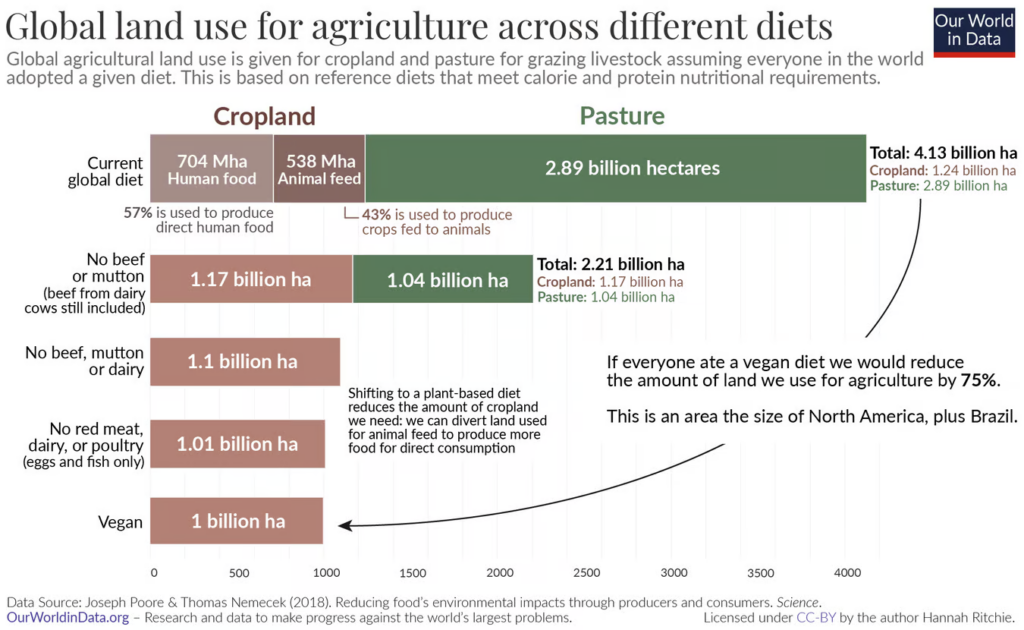
This is in contrast to the 16% of all agricultural land that’s used to grow crops for humans & the 1% urban & built-up land.
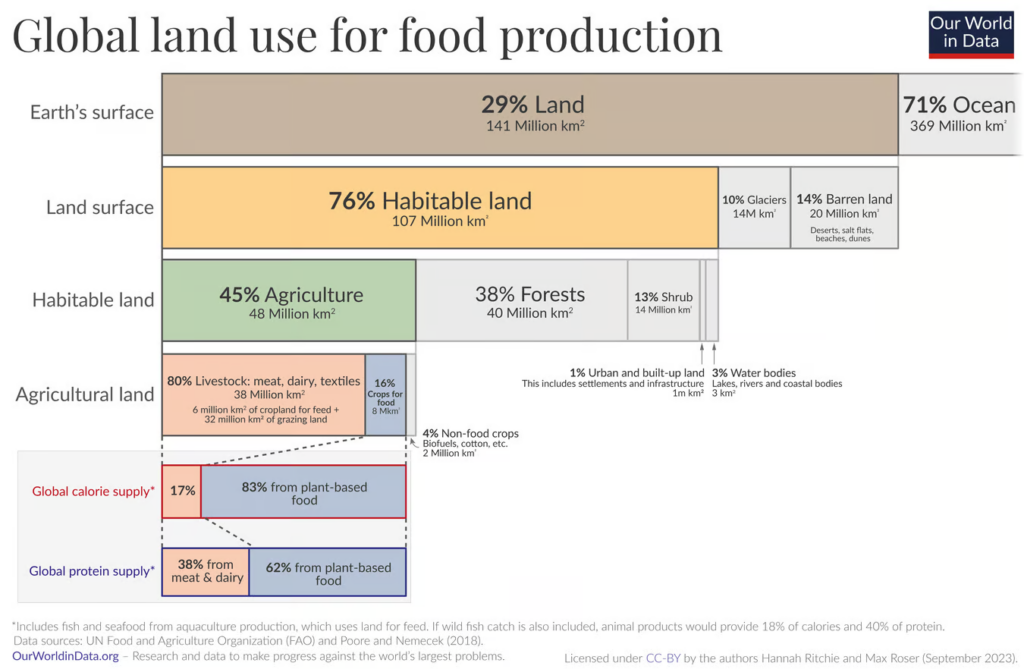
Despite the vast land used for livestock animals, they contribute quite a small share of the global calorie and protein supply. Meat, dairy, and farmed fish provide just 17% of the world’s calories and 38% of its protein.
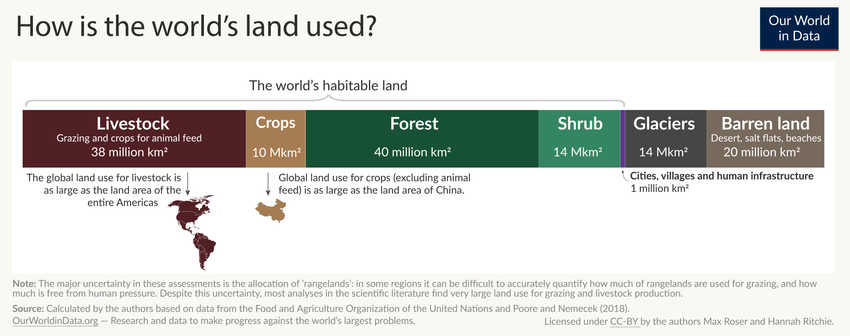
But land use is not the only driver of climate change from animal agriculture, it is also responsible for greenhouse gas emissions, freshwater withdrawals and biodiversity loss among others.
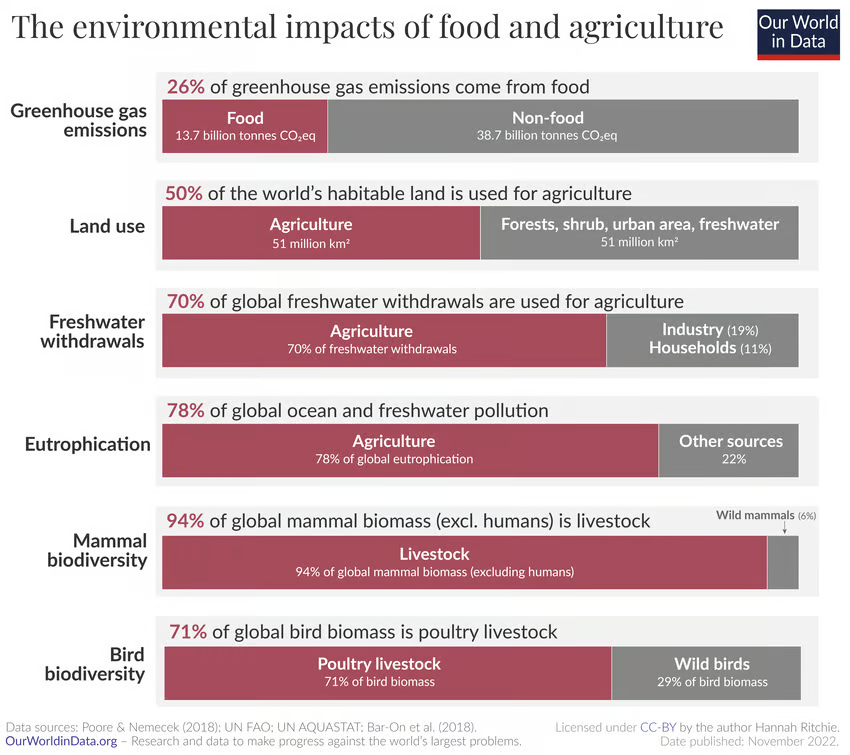
That’s why there have been repeated calls from academics over the years about how we are literally Eating our way to Extinction. On 8 August 2019, the IPCC (Inter-governmental Panel for Climate Change) released a summary of the 2019 special report which asserted that a shift towards plant-based diets would help to mitigate and adapt to climate change.
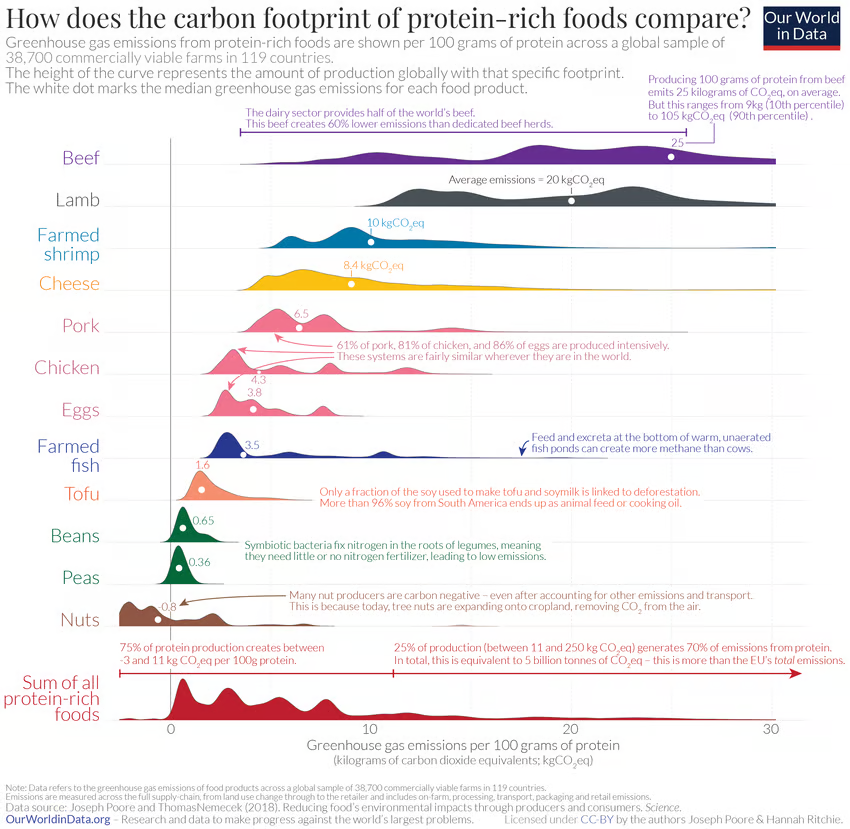
What about the carbon footprint of different foods?
The most effective way to reduce greenhouse gas emissions from the food system is to change what we eat.
Okay, but isn’t UK more sustainable?
Data below from Our World in Data shows that in the last 150 years, the UK lost close to 50% of its cropland but increased grazing land over 200%.
Our recent State of Nature report tells us that nearly one in six species (16%) are threatened with extinction in Great Britain.
According to data provided by the Food and Agriculture Organization of the United Nations, 1.1 billion land animals were slaughtered for food in the United Kingdom in 2016. In addition, roughly 5% of farmed land animals die before slaughter. Inclusive of these deaths, U.K. industrial farming claimed the lives of 1.155 billion land animals in 2016. Marine animal deaths are challenging to calculate since these lives are measured in tonnes. Exclusive of bycatch and feed fish, the U.K. food supply included 876 million fish and 4.3 billion shellfish (see reference section for details).
Taken together, 6.4 billion land and sea animals are killed annually to support the U.K. food supply.
According to November 2024 statistics published by AHDB, the UK imported a combined total of 5.37 million tonnes of maize and wheat, accounting for approximately 42.5% of the total cereal consumption by animal agriculture, which stands at 12.63 million tonnes.
Then what about Fife?
Our recent Freedom of Information request to SEPA suggests farms across Fife house over 157,400 mammals (sheep, cattle, pigs) and 1 million poultry birds. These numbers have remained alarmingly high over the past six years, fuelling greenhouse gas emissions and environmental degradation. The land use for animal agriculture in Fife is close to 46% of total agricultural land, that’s roughly 45K Ha. Scotland also imported over 3.8 million tonnes of animal feed in five years, much from deforestation-linked countries like Argentina and Brazil. As of the last survey done by The Bureau of Investigative Journalism back in 2017, three of the top 20 polluters of Ammonia (faecal excrements from animal agriculture) are from Fife producing over 68,000 kilograms of waste. And Fife sits at the top four Ammonia polluting councils in all of Scotland. The numbers are only expected to have increased as governments have since approved more mega-farms across the UK.
But most of UK’s agricultural land is not suitable for arable farming so we will be reliant on imports to feed our nation which is surely bad?
Netherlands has 1/5th the arable land of the UK but produce twice the number of crops and end up exporting most of them all around the EU and even to the UK. The UK’s heavy reliance on farming subsidies—£5 billion for England over two years and £650 million for Scotland in 2024—highlights inefficiencies, particularly in animal agriculture, which consumes vast resources and produces fewer calories per hectare than crops grown for direct human consumption. Transitioning to plant-based agriculture, redirect subsidies toward sustainable practices, and invest in technologies that maximize productivity will help the UK create a more resilient, efficient, and environmentally friendly food system.
Is it not better to eat locally sourced meat than to import soy & avocados from abroad?
The visualization below shows GHG emissions from 29 food products — from beef at the top to nuts at the bottom.
For each product, you can see from which stage in the supply chain its emissions originate. This extends from land use changes on the left to transport and packaging on the right.
This is data from the largest meta-analysis of global food systems to date, published in Science by Joseph Poore and Thomas Nemecek (2018).
In this study, the authors examined data from more than 38,000 commercial farms in 119 countries.
This shows how you can have a larger difference by focusing on what you eat, rather than ‘eating local’.
Okay, can I not just offset my food emissions with other ways of being sustainable instead?
One-quarter to one-third of global greenhouse gas emissions come from our food systems. The rest comes from energy.
While energy and industry make a bigger contribution than food, we must tackle both food and energy systems to address climate change.
Michael Clark and colleagues modelled the amount of greenhouse gas emissions that would be emitted from food systems this century across a range of scenarios.
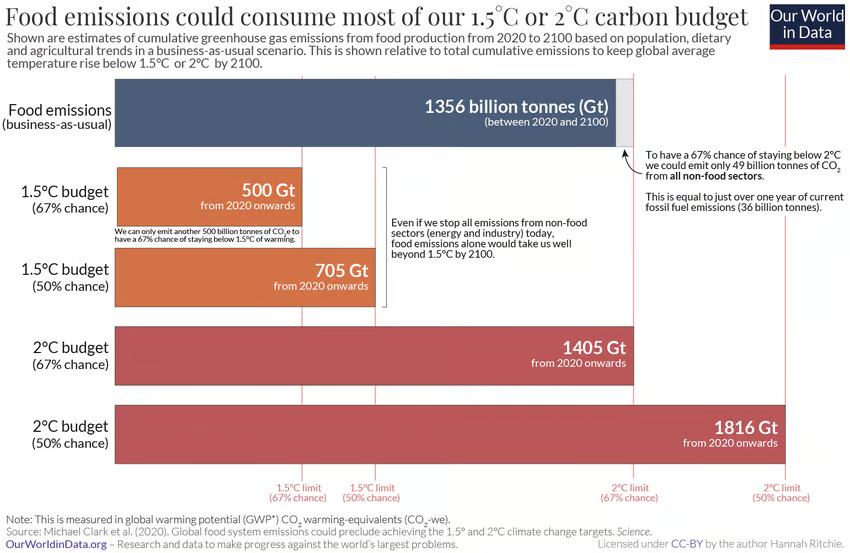
In a business-as-usual scenario, the authors expect the world to emit around 1356 billion tonnes of CO2-we by 2100.
As the visualization shows, this would take us well beyond the carbon budget for 1.5°C – we would emit two to three times more than this budget. And it would consume almost all of our budget for 2°C.
Ignoring food emissions is simply not an option if we want to get close to our international climate targets.
Even if we stopped burning fossil fuels tomorrow – an impossibility – we would still go well beyond our 1.5°C target, and nearly miss our 2°C target.
Is a vegan diet really that climate friendly?
Our food system is currently responsible for 13.7 billion tonnes of carbon dioxide equivalents (GtCO2e) each year. That’s one-quarter (26%) of total greenhouse gas emissions.
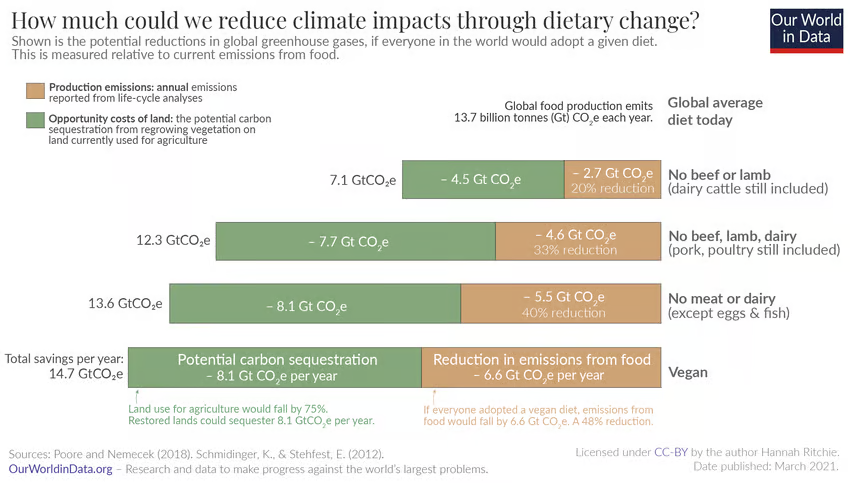
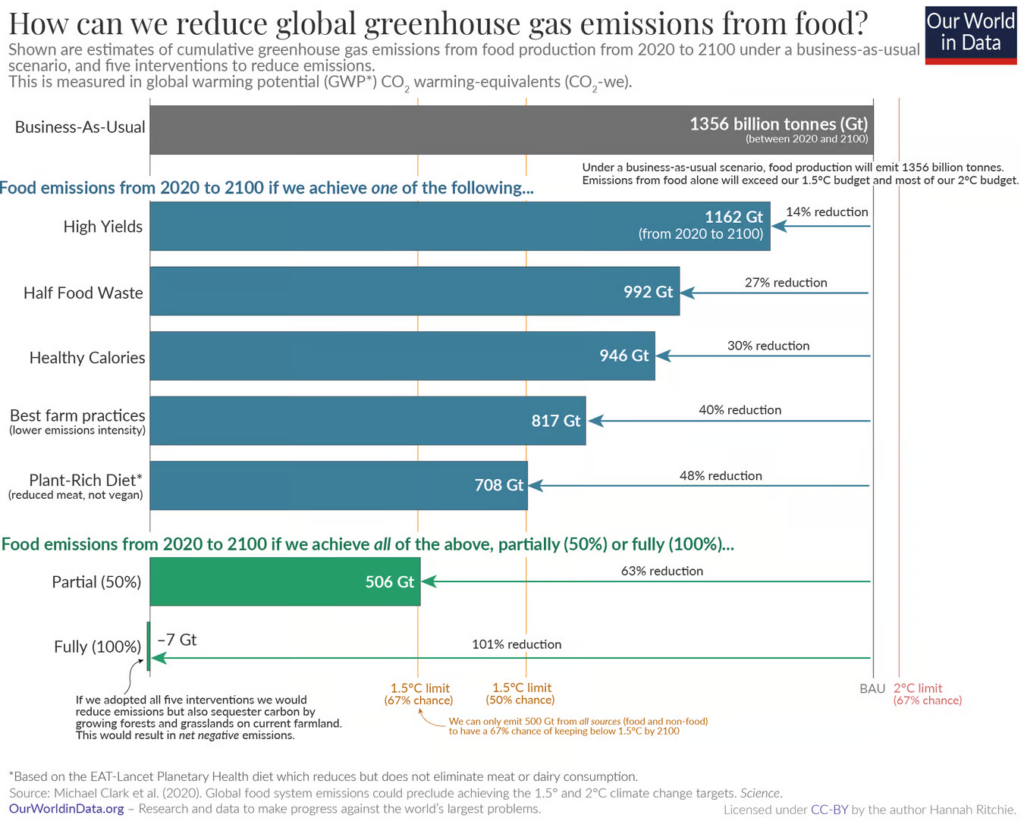
If everyone would decide to become vegan we would achieve the largest carbon reduction. We could halve annual emissions from food production. And, switching to a vegan diet would reduce our agricultural land use by 75%. This means we could sequester an additional 8 billion tonnes of CO2 in vegetation and soils each year. Combined, this would reduce greenhouse gases by 14.7 billion tonnes of CO2e each year.
Thankfully there is no trade-off between production emissions and opportunity costs: what reduces emissions the most also results in the greatest reduction in opportunity costs. Shifting to a more plant-based diet achieves both.
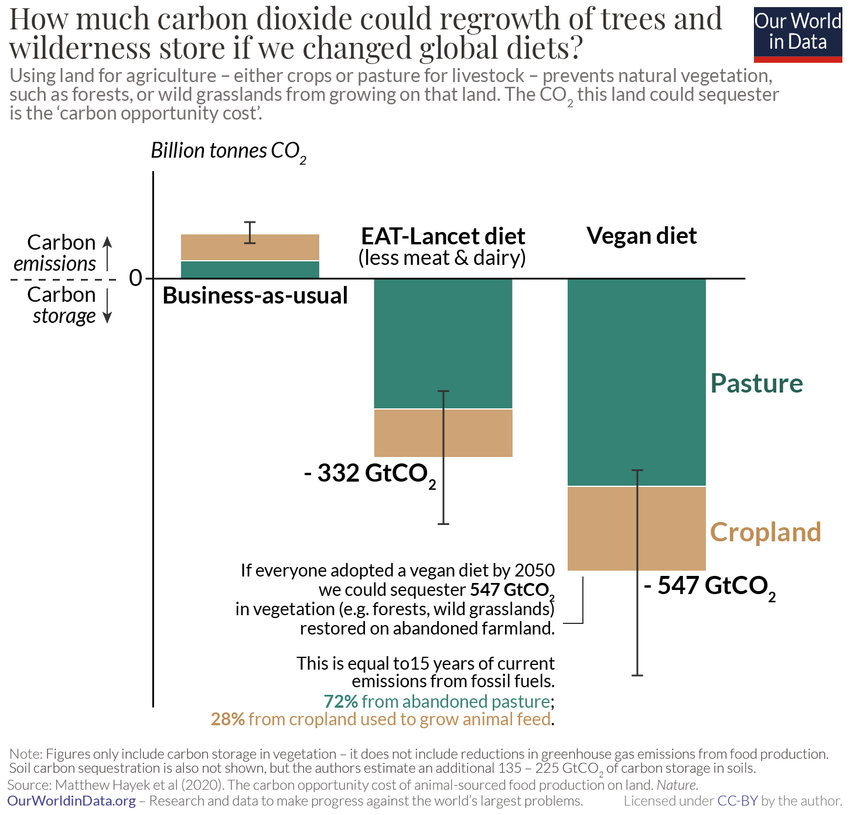
In a hypothetical scenario in which everyone in the world went vegan by 2050, the regrowth of trees and wilderness could sequester around 547 billion tonnes of additional CO2. Each year we emit around 36 billion tonnes of CO2 from fossil fuels, so that’s equal to around 15 years of emissions at our current levels. They also estimate an additional 225 billion tonnes of CO2 could be stored in soils, although soil sequestration estimates are more uncertain. However we see it, the science behind carbon opportunity costs of food is undeniable.
To conclude, even Fife Council acknowledges that adopting a vegan diet is one of the most effective ways to make a significant positive impact on climate change.